
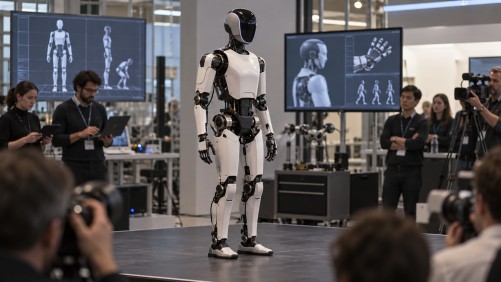
OpenAI is gearing up to extend its artificial intelligence capabilities into the realm of humanoid robotics, with plans to demonstrate its technology by 2027. CEO Sam Altman has indicated that this initiative aims to move AI beyond digital spaces and into physical environments, a challenging endeavor that requires developing AI systems capable of understanding their surroundings, interpreting instructions, and controlling physical machines effectively.
The design of a humanoid robot is seen as advantageous due to its potential to operate seamlessly in spaces designed for humans. However, OpenAI has yet to disclose the final design, technical details, or exact capabilities of the proposed robot. This project demands significant advancements in areas such as perception, movement, decision-making, and the coordination of mechanical components to ensure safety and functionality in real-world tasks.
To achieve these goals, OpenAI is actively recruiting experts in fields like robotics software, hardware, control systems, motion technologies, motor design, machine learning, and manufacturing. These efforts underscore the company’s commitment to building a comprehensive technological infrastructure for practical robotic applications.
OpenAI faces competition from other companies pursuing similar ambitions. Tesla is developing its Optimus humanoid robot, while Chinese automaker XPENG has showcased its IRON robot. These projects illustrate a growing interest in integrating AI with machines capable of performing physical tasks.
Beyond developing humanoid robots, OpenAI’s broader vision includes creating general-purpose robots that could assist skilled workers in infrastructure construction and potentially support a wide range of everyday activities. The company is also exploring various robotic designs that extend beyond the humanoid form, emphasizing its commitment to innovation in robotics.