
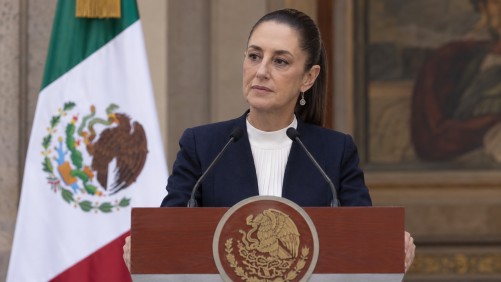
Mexican President Claudia Sheinbaum is actively engaging with both domestic and international businesses to bolster economic growth by increasing private investment. The government has facilitated the progress of over 20 investment projects, collectively valued at about $3.75 billion in 2023, with a significant focus on the electricity sector. This initiative underscores the executive branch’s strengthened collaboration with companies to eliminate investment barriers, according to the Business Coordinating Council of Mexico.
In a recent meeting with Mexican and American business leaders, including U.S. Ambassador to Mexico Ronald Johnson, Sheinbaum discussed enhancing bilateral economic relations and exploring investment opportunities in key industries such as semiconductors, railways, financial services, and medical devices. The discussions also touched upon trade relations, tariffs, and the future of the United States-Mexico-Canada Agreement (USMCA). Following these talks, Sheinbaum announced Nestlé’s plan to invest $2 billion in Mexico throughout her six-year term, with other business representatives showing interest in expanding their investments in the country.
The Mexican government is increasingly depending on private capital to sustain economic activity while aiming to reduce the fiscal deficit. Despite Mexico’s economy growing by just 0.8% in 2025, the Finance Ministry forecasts a growth rate of 1% to 2% for 2026. Foreign direct investment has reached nearly $35 billion in the first half of the year, though domestic private investment remains the larger portion of overall investment. Under the Plan México initiative, the government aims to attract over 5.6 trillion pesos in combined public and private investment by 2030 across various sectors, including energy and transportation.
To achieve these goals, the administration is pursuing legislative changes to enhance access to investment financing and credit, with the hope of encouraging businesses to embark on new projects and strengthen Mexico’s productive capacity. However, economic analysts have voiced concerns that uncertainties surrounding U.S. trade policy, potential tariffs, and the forthcoming USMCA review could deter large-scale investments. Additionally, issues such as regulatory changes, legal certainty, and water access remain crucial factors influencing business decisions.
While recent investment data offers some optimism, with Mexico’s gross fixed capital formation increasing by 6% year-on-year in July and private investment growing by 5.9%, analysts caution against assuming a sustained recovery in investor confidence from just one month of growth. The future of Mexico’s economic outlook will partially depend on its ability to maintain robust trade ties with the United States and Canada while addressing internal investment barriers. The Sheinbaum administration is betting on closer business engagement, improved financing opportunities, and expedited project approvals to drive economic growth and attract further capital.